This morning the runners stretched their legs and I wrote the first blog of this trip. Two locations were considered and with our hosts driving we went to the villages of Saksun and then onto Tjœrnuvik. The Faroes are so closely linked with the sea - I know that stating it may be so obvious as to be absurd - but the closeness of houses to water highlights this. The fjords and the open sea provides what has sustained these people over centuries.
We passed salmon farms too which I suppose is one way of being more sustainable than taking from the wild. However, in the Scottish Sunday Times the headline reads 'Seals shot to save Waitrose Salmon' followed by a quote 'if seals keep attacking the fish, then, like a farmer kills foxes, we shoot them'. It appears there are killers everywhere who justify to themselves that it is justified! The Wild is dangerous and then disease threatens the seal population and there is every need to be concerned.
I don't think that words would be enough to describe what we saw today.
Saksun is at the end of a finger of water that stretches out to sea. The hanging waterfalls and high ridges on either side are majestic. The vividness of the greens of the pastures are emphasized by the dark lines of ditches and boulders. Sheep dotted the hillsides. It was a pleasure to be there.
I was concentrating on the birds and their national bird, the Oyster Catcher, is everywhere and their calls are constant. Fulmars were on the crags and there was the occasional Herring Gull with a good number of Lesser-black Backed Gulls. An Arctic Tern fished nearby. We eventually identified a female Common Eider with three young. On the edge of a fjord were numerous male Eiders and in one group there were at least thirty. One Hare was spotted and that is the only land mammal apart from a House Mouse - and neither are indigenous.
At Tjœrnvnik we indulged in waffles, cream and strawberry jam where we sat outside and drank coffee. On the edge of the bay were two large stones. One was said to be a witch and the other a giant who agreed to tow the Faroes to link up with Iceland. Daylight came too soon and now they are fixed in stone for ever. That's one way of getting stoned and being enshrined in folk law.
On the way back to a fish and chip supper we saw gigg racing and later watched a re-run on TV. Good luck to them for a superb effort is required to get those boats moving through the water. The weather was kind and the sun shone and at 9am it was twelve degrees. We had some rain and the breeze was light. What a day and again Vodafone failed to solve the issues of no outward going calls or even inward ones. Money for nothing and it wasn't free. We have no consumer or consideration given to us from VODAFONE. IT APPEARS THAT THEY DON'T CARE. Tomorrow is another day.
Thursday, 29 June 2017

Wednesday, 28 June 2017
Summer visit to the Faroes
"We are going to the Faroe Islands" we say and apart from the fact that it gets translated into Fiji, Falkland Islands and, more logically, Faro in Portugal and then we can get "they kill whales. Don't they?
Well, they do and it has been happening this week. I don't like and I don't agree with it and if I say that it is their culture and that it is traditional I know somebody that would shout and swear at me.
All the content in the above three lines are true. I said that I would blog this trip 'warts and all' and that I will include everything that is good and beautiful and that is what I will do. I will attempt to give a balanced view of the people here and what I can see as I look out of the window. That backdrop of fields, rocky outcrops, coloured houses and the sun shining on the sea is a sight worth remembering. It is an experience and there are, and will be, many of them that will linger in the memory.
I have taken several days in getting to the point of writing anything, but I have been reflecting on matters and events that have been there in my life and formed my early thinking and more latterly on what my views have developed into.
Now to reminisce, just a little. I can remember the otter hounds meeting in my village before trotting away to our local river. Although the fox hounds were never allowed to hunt on the farm there were several occasions when stray hounds trotted past the house. Okay, the propaganda being said that foxes were wanton killers and would kill more that they could possibly eat. Also there was the 'a shilling' bounty which was redeemable when the tail of the Grey Squirrel was presented. Add into that pheasant shoots and for fifteen shillings a day I could encourage them to fly toward the guns. Rabbits, before Myxomatosis, grazed the edge of fields and meadows up to about five metres or so. Yes they consumed what we needed to eat, but they were the poor man's chicken! Add into that mix Grey Partridge, Wood Pigeons, Hares, Woodcock and other beautiful birds that were targets for the 'landed gentry', gamekeepers and for anyone who owned a gun. On the good side that was when there were good habitats for song birds, wide field margins and hedgerows. 'PROGRESS' has changed all that and so for every one that says 'thou shall not kill whales' and I will agree with them, but I have looked hard at myself and would encourage everyone to look at what is happening at home - First.
I follow RaptorPersecution and I am appalled at what killing goes on. I am not speaking about killing for food, but they say that the killing of raptors is necessary to protect pheasant and grouse chicks that are bred in pens, fed with manufactured food with added chemicals. All being bred and cared for, and only for the sole purpose of being made to fly into a hail of lead shot. And this is called sport by some.
On the various blog entries that I read for England I hear of shot Peregrine Falcons, Red Kites, Buzzards, Sparrow Hawks and only a few days ago a Short-Eared Owl. Why kill such beautiful things? Maybe it is because they can! It seems to be even worse in Scotland where the driven grouse moors seem to encourage wanton slaughter of everything that appears to them to be in competition with their bloody grouse including the mass slaughter of Mountain Hares. I have written about this before.
I could say much more.
Now briefly to here and now. We are having a cracking time in Tóshavn. It is beautiful and so are the people that we staying with. The view from the windows both landward and seaward are terrific. We have erected a marquee, sat, drank and chatted in it. We have been entertained by a choir singing in harmony. All this was for the end of school term and graduation. Then we took the marquee down so efficiently that we could go into business!
We managed a short trip down to the town and the harbour. Sat in the sun with a cake and beer and took it easy. Yes, we saw a small quantity of meat for sale on the quay side which is what we did not want to see, but they do eat it.
The fun for me is VODAFONE. I spent £27.50 in their shop in Edinburgh so that we can keep in touch with Europe. It doesn't work and for two days two people are in constant chat with Vodafone staff somewhere. But only by text and with no ability to phone out. It is annoying, but I don't care. My phone is still switched off. I am having such fun.
Well, they do and it has been happening this week. I don't like and I don't agree with it and if I say that it is their culture and that it is traditional I know somebody that would shout and swear at me.
All the content in the above three lines are true. I said that I would blog this trip 'warts and all' and that I will include everything that is good and beautiful and that is what I will do. I will attempt to give a balanced view of the people here and what I can see as I look out of the window. That backdrop of fields, rocky outcrops, coloured houses and the sun shining on the sea is a sight worth remembering. It is an experience and there are, and will be, many of them that will linger in the memory.
I have taken several days in getting to the point of writing anything, but I have been reflecting on matters and events that have been there in my life and formed my early thinking and more latterly on what my views have developed into.
Now to reminisce, just a little. I can remember the otter hounds meeting in my village before trotting away to our local river. Although the fox hounds were never allowed to hunt on the farm there were several occasions when stray hounds trotted past the house. Okay, the propaganda being said that foxes were wanton killers and would kill more that they could possibly eat. Also there was the 'a shilling' bounty which was redeemable when the tail of the Grey Squirrel was presented. Add into that pheasant shoots and for fifteen shillings a day I could encourage them to fly toward the guns. Rabbits, before Myxomatosis, grazed the edge of fields and meadows up to about five metres or so. Yes they consumed what we needed to eat, but they were the poor man's chicken! Add into that mix Grey Partridge, Wood Pigeons, Hares, Woodcock and other beautiful birds that were targets for the 'landed gentry', gamekeepers and for anyone who owned a gun. On the good side that was when there were good habitats for song birds, wide field margins and hedgerows. 'PROGRESS' has changed all that and so for every one that says 'thou shall not kill whales' and I will agree with them, but I have looked hard at myself and would encourage everyone to look at what is happening at home - First.
I follow RaptorPersecution and I am appalled at what killing goes on. I am not speaking about killing for food, but they say that the killing of raptors is necessary to protect pheasant and grouse chicks that are bred in pens, fed with manufactured food with added chemicals. All being bred and cared for, and only for the sole purpose of being made to fly into a hail of lead shot. And this is called sport by some.
On the various blog entries that I read for England I hear of shot Peregrine Falcons, Red Kites, Buzzards, Sparrow Hawks and only a few days ago a Short-Eared Owl. Why kill such beautiful things? Maybe it is because they can! It seems to be even worse in Scotland where the driven grouse moors seem to encourage wanton slaughter of everything that appears to them to be in competition with their bloody grouse including the mass slaughter of Mountain Hares. I have written about this before.
I could say much more.
Now briefly to here and now. We are having a cracking time in Tóshavn. It is beautiful and so are the people that we staying with. The view from the windows both landward and seaward are terrific. We have erected a marquee, sat, drank and chatted in it. We have been entertained by a choir singing in harmony. All this was for the end of school term and graduation. Then we took the marquee down so efficiently that we could go into business!
We managed a short trip down to the town and the harbour. Sat in the sun with a cake and beer and took it easy. Yes, we saw a small quantity of meat for sale on the quay side which is what we did not want to see, but they do eat it.
The fun for me is VODAFONE. I spent £27.50 in their shop in Edinburgh so that we can keep in touch with Europe. It doesn't work and for two days two people are in constant chat with Vodafone staff somewhere. But only by text and with no ability to phone out. It is annoying, but I don't care. My phone is still switched off. I am having such fun.
Monday, 24 April 2017
OUR LAST FULL DAY WITH WILD POLAND (Friday March 24th updated with photographs)
On our last morning it was an early start to see Elk. However outside the hotel I had very close views of both Tree Sparrow, Robin and a pair of Linnets perched within 20 meters. We soon found five Elk close to the road and the photographers got busy. Further on in a flooded field there were two Common Cranes feeding and in front of them five Greylag Geese and it got better. Redshanks called and flew, Snipe were drumming and then flew. In addition there were Lapwing exhibiting their crazy flight. It was a magic few minutes.


After breakfast the objectives were to be waders, Ducks and Geese. We were in an active area for many varieties of birds. The idea was to find a field that did not look like a lake and many fields were totally flooded.
Near the river we had good views of:
Wigeon - in large numbers
Common Pochard
Teal
Tufted Duck
Garganey - three female and one male seen, but I only saw them fly in and out.
Pintail
Geese flying over as usual
Buzzard - another one as usual, but not in any number.
White Tailed Eagle - two good flying views.
Ruff - several good views
Black Tailed Godwits.
Great Crested Grebe.
Cormorants flew over
We passed Roe Deer grazing in the fields and that there is one of the groups of Roe that favour such an habitat while others are forest animals that stray no further than the edge of the trees.
Instead of a packed lunch we went to a bar overlooking the River Bialowieza at Rús. It was easy to get being on the side of a main road and with a patio overlooking the river and flooded valley.
Skylarks were everywhere and could be viewed even on the ground
The afternoon was spent looking at expanses of water and seeing what was on it. We had some real treats.


On one area just above the water level we saw three species of geese - Greylag, Bean and White Fronted.
This also was a good place for all ducks. The common birds listed before are not mentioned again here, but we did see:
Pintail
Shovelers
Smew - both male and female
Golden Eye
SAWBILLS
Goosanders - two female
GULLS
Black Headed
Herring Gull twice and possibly the same bird and a second year.
White Wagtail.
ALSO
Fieldfare in very good numbers.
White Stork and on nest too.
Cranes in many fields
Great Grey Shrike.
Reed Bunting
Red Fox - probably a dog and in very good condition.
There were in addition very good sightings of both Elk and Roe Deer.
And again we weren't finished as the cold wind felt colder and the light began to get less we went to the village of Goniatz. It sits just above the Biebrza River that had expanded across the flood plain. The sunset was another memorable one as we watched about a dozen Great White Egrets come into roost on an 'island' with one Grey Heron.
The whole group has completed a full list for each day of every species seen. I have not included all birds seen every day and tried to be as informative that I can be without being repetitive. We had some very sharp eyed persons in our group and with their knowledge and the knowledge and experience of Andrzej we had confirmation of all species. There was no guessing!


After breakfast the objectives were to be waders, Ducks and Geese. We were in an active area for many varieties of birds. The idea was to find a field that did not look like a lake and many fields were totally flooded.
Near the river we had good views of:
Wigeon - in large numbers
Common Pochard
Teal
Tufted Duck
Garganey - three female and one male seen, but I only saw them fly in and out.
Pintail
Geese flying over as usual
Buzzard - another one as usual, but not in any number.
White Tailed Eagle - two good flying views.
Ruff - several good views
Black Tailed Godwits.
Great Crested Grebe.
Cormorants flew over
We passed Roe Deer grazing in the fields and that there is one of the groups of Roe that favour such an habitat while others are forest animals that stray no further than the edge of the trees.
Instead of a packed lunch we went to a bar overlooking the River Bialowieza at Rús. It was easy to get being on the side of a main road and with a patio overlooking the river and flooded valley.
Skylarks were everywhere and could be viewed even on the ground
The afternoon was spent looking at expanses of water and seeing what was on it. We had some real treats.


On one area just above the water level we saw three species of geese - Greylag, Bean and White Fronted.
This also was a good place for all ducks. The common birds listed before are not mentioned again here, but we did see:
Pintail
Shovelers
Smew - both male and female
Golden Eye
SAWBILLS
Goosanders - two female
GULLS
Black Headed
Herring Gull twice and possibly the same bird and a second year.
White Wagtail.
ALSO
Fieldfare in very good numbers.
White Stork and on nest too.
Cranes in many fields
Great Grey Shrike.
Reed Bunting
Red Fox - probably a dog and in very good condition.
There were in addition very good sightings of both Elk and Roe Deer.
And again we weren't finished as the cold wind felt colder and the light began to get less we went to the village of Goniatz. It sits just above the Biebrza River that had expanded across the flood plain. The sunset was another memorable one as we watched about a dozen Great White Egrets come into roost on an 'island' with one Grey Heron.
The whole group has completed a full list for each day of every species seen. I have not included all birds seen every day and tried to be as informative that I can be without being repetitive. We had some very sharp eyed persons in our group and with their knowledge and the knowledge and experience of Andrzej we had confirmation of all species. There was no guessing!
A FEW HOURS IN THE RED MARSH - NOW WITH PHOTOGRAPHS
Thursday 23rd March saw a frosty morning and at 8.45 we were ready to go for several hours and with a need of Wellington Boots.

Our destination was the Red Marsh which is a vast area and where there is said to be a population of one thousand Elk. Apparently the water levels were too high to drive through and around. Eventually we were allowed limited access and to reach a good vantage point we walked for just under an hour with an estimated distance of three and half kilometers. As we waited for access we saw a male Black Redstart - it had to be an early arrival. In an adjacent paddock there was a Konic Stallion which is a descendent of the first horses and now used in the U.K. for habitat management.

On the way we passed a monument to the villagers that were taken into the forest and shot by the Germans. We saw several such sites on previous days. Again there is so much history.
In the birding sense it was a very quiet day. The habitat that we were in is poor for many species.
On the walk we passed a sanctuary for Wild Boar, Elk and Raptors. I have noticed that there are people who care about the environment and nature. We were on a sandy track that enabled us to see prints of Elk, Wild Boar, Wolf and Fox. Also Wolf dropping indicated their diet of Boar and on one pile was an Orange Underwing Moth. A very good spot for the more observant. And we saw both male and female Brimstone Butterflies flying through the trees. There were some birds around including Raven, Buzzard and in the distance a male Marsh Harrier was see.

One area we walked on a boardwalk which was over a raised bog. Growing on it and through it were Birch Trees and really it could be any swamp, but it wasn't. Another special treat for us and something completely different.
We had been out all day and after a quick evening meal we travelled to Wizna Village on the Narew River where we looked for Beavers from a boat with the aid of spotlights. The Beavers seemed not to pay that much attention to the sound of the boat engine or to the light. In fact they swam into a beam. We watched one for about 15 minutes as it chewed away and from time to time scratched itself apparently unconcerned with human presence about 20 metres away. I am told that they do react to human voices. We had some wonderful views and Michelle was able to photograph them.


In the beam of the light there were insects flying and Pipistrelle Bats too. Also I caught sight of a Kingfisher as it flew across.
It was a cold evening with a slight sleet shower and then we headed back to the hotel and a beer.
It was a tough day for the legs and feet and we completed over twenty thousand steps according to Fitbit.

Our destination was the Red Marsh which is a vast area and where there is said to be a population of one thousand Elk. Apparently the water levels were too high to drive through and around. Eventually we were allowed limited access and to reach a good vantage point we walked for just under an hour with an estimated distance of three and half kilometers. As we waited for access we saw a male Black Redstart - it had to be an early arrival. In an adjacent paddock there was a Konic Stallion which is a descendent of the first horses and now used in the U.K. for habitat management.

On the way we passed a monument to the villagers that were taken into the forest and shot by the Germans. We saw several such sites on previous days. Again there is so much history.
In the birding sense it was a very quiet day. The habitat that we were in is poor for many species.
On the walk we passed a sanctuary for Wild Boar, Elk and Raptors. I have noticed that there are people who care about the environment and nature. We were on a sandy track that enabled us to see prints of Elk, Wild Boar, Wolf and Fox. Also Wolf dropping indicated their diet of Boar and on one pile was an Orange Underwing Moth. A very good spot for the more observant. And we saw both male and female Brimstone Butterflies flying through the trees. There were some birds around including Raven, Buzzard and in the distance a male Marsh Harrier was see.

One area we walked on a boardwalk which was over a raised bog. Growing on it and through it were Birch Trees and really it could be any swamp, but it wasn't. Another special treat for us and something completely different.
We had been out all day and after a quick evening meal we travelled to Wizna Village on the Narew River where we looked for Beavers from a boat with the aid of spotlights. The Beavers seemed not to pay that much attention to the sound of the boat engine or to the light. In fact they swam into a beam. We watched one for about 15 minutes as it chewed away and from time to time scratched itself apparently unconcerned with human presence about 20 metres away. I am told that they do react to human voices. We had some wonderful views and Michelle was able to photograph them.


In the beam of the light there were insects flying and Pipistrelle Bats too. Also I caught sight of a Kingfisher as it flew across.
It was a cold evening with a slight sleet shower and then we headed back to the hotel and a beer.
It was a tough day for the legs and feet and we completed over twenty thousand steps according to Fitbit.
Saturday, 22 April 2017
ON THE MOVE FROM BIALOWIEZA TO BIEBRZA. (Day 4, March 22nd updated with photographs)
I can say that we have not wasted a minute of our time with Wild Poland. All of it has been extremely well planned and our guide Andrzej has moved us from location to location to ensure that we see the maximum possible. We have now moved from Wejmutka (our excellent accommodation) in Bialowieza and we are now in the area of Biebrza Marsh and staying at Dwor Dobraz The journey which did take all day was 160 kilometers with stops on the way.
This morning before leaving we again visited Palace Park. This time it was dry and fairly warm. One of my 'bogey' birds has been Tree Sparrow and today I had a clear uninterrupted view of one and then later in the day we saw more of them. A Song Thrush was singing in full view and there was a Tufted Duck on the lake. (See yesterday's list for other birds). Woodpeckers were drumming and calling and we were surrounded by birdsong. A Dunnock was seen by two of our party.
ON ROUTE
Collared Doves
Rooks and a Rookery in Balystok
Wood Pigeon
Jackdaws
Hooded Crows
Roe Deer
Cranes in pairs - on several,occasions.
Our first stop was at Dojlidy Fish Ponds near Balystok and this is a fantastic area of water with large reedbeds. We saw:
American Mink - one ran across the track.
Greylag Geese
Wigeon
Golden Eye
Black Headed Gulls - this is a breeding area and they were in large numbers.
Bittern - heard several times
Common Gull X 2. Possible a first year and a second year
Raven
Coot
Geese flying over - one skein one way and three the other way! Several hundred. From their calls White Fronted although it there could have been other species flying too. They were high in the sky.
We had terrific views of Bearded Reedlings as they called, darted through the reeds and called. They were within a few feet of us and were photographed. A memorable few minutes.


Lunch was at Waniewo in the Narew River Park. This is another amazing area with a vast expanse of water. The food was wonderful with cottage cheese pancakes and blackcurrent jam and various hams and cheese.

 Afterwards we saw:
Buzzard
White Tailed Eagle - in distance only
Osprey - a possible juvenile
Linnet
Mallard
Blue Tit
Great Tit
Yellow Hammer
Sky Larks - several singing
Great Crested Grebes
Pintail male - I missed this one
After reaching Dwor Dobraz our hotel accommodation we went out to nearby Gugny and a viewing platform and we saw:
Elk in the distance @ 7
Roe Deer - on route and seen near our destination several times.
Woodcock feeding on the side of the road.
Common Toads again.
Geese X 30- thought to be Bean as they flew over.
Sounds of Greylag geese from the marsh at dusk. They are the only geese that breed here.
This was another full day with 160 k journey broken up with excellent places to see birds and wildlife. This area is vast and there is so much to hear, see and do. We are having a wildlife ball!
I am enjoying every minute of it and so well done to Wild Poland.
This morning before leaving we again visited Palace Park. This time it was dry and fairly warm. One of my 'bogey' birds has been Tree Sparrow and today I had a clear uninterrupted view of one and then later in the day we saw more of them. A Song Thrush was singing in full view and there was a Tufted Duck on the lake. (See yesterday's list for other birds). Woodpeckers were drumming and calling and we were surrounded by birdsong. A Dunnock was seen by two of our party.
ON ROUTE
Collared Doves
Rooks and a Rookery in Balystok
Wood Pigeon
Jackdaws
Hooded Crows
Roe Deer
Cranes in pairs - on several,occasions.
Our first stop was at Dojlidy Fish Ponds near Balystok and this is a fantastic area of water with large reedbeds. We saw:
American Mink - one ran across the track.
Greylag Geese
Wigeon
Golden Eye
Black Headed Gulls - this is a breeding area and they were in large numbers.
Bittern - heard several times
Common Gull X 2. Possible a first year and a second year
Raven
Coot
Geese flying over - one skein one way and three the other way! Several hundred. From their calls White Fronted although it there could have been other species flying too. They were high in the sky.
We had terrific views of Bearded Reedlings as they called, darted through the reeds and called. They were within a few feet of us and were photographed. A memorable few minutes.


Lunch was at Waniewo in the Narew River Park. This is another amazing area with a vast expanse of water. The food was wonderful with cottage cheese pancakes and blackcurrent jam and various hams and cheese.


Buzzard
White Tailed Eagle - in distance only
Osprey - a possible juvenile
Linnet
Mallard
Blue Tit
Great Tit
Yellow Hammer
Sky Larks - several singing
Great Crested Grebes
Pintail male - I missed this one
After reaching Dwor Dobraz our hotel accommodation we went out to nearby Gugny and a viewing platform and we saw:
Elk in the distance @ 7
Roe Deer - on route and seen near our destination several times.
Woodcock feeding on the side of the road.
Common Toads again.
Geese X 30- thought to be Bean as they flew over.
Sounds of Greylag geese from the marsh at dusk. They are the only geese that breed here.
This was another full day with 160 k journey broken up with excellent places to see birds and wildlife. This area is vast and there is so much to hear, see and do. We are having a wildlife ball!
I am enjoying every minute of it and so well done to Wild Poland.
Thursday, 20 April 2017
DAY THREE IN BIALOWEIZA (March 21st updated with photographs)
On Tuesday 21st March we had a series of short walks which is different from the previous two days. I was up at 5.30am and only four of us went out for a walk in the town park, Palace Park, which was formally for the Russian Czars. Nicholas Second's Palace once stood here but all that remains are some stables. On the site now stands an imposing building which houses a museum and the offices for the Park Authority. There must be so much history here if only we had time.


It was raining heavily when we stepped outside and the temperature was at least seven degrees.
Bullfinches were everywhere
Siskins were flying in a flock and feeding on the ground.
Waxbills again for the third time - Fantastic and much closer to see.
Chaffinch
Great and Blue Tits were in the trees.
Reed Buntings
Lesser Spotted Woodpecker called and then it flew from tree to tree landing on the trunks at our level. It was a female and this is the best view that I have ever had.
Black Headed Gulls flew over.
On the lake we saw:
Golden Eye - one male and two females
Mallard
Wigeon
Great White Egret
Grey Herons X two.
Around the lake there was ample evidence of Beaver. There was one tree with a diameter of more than two feet with only the core not eaten through. Other trees they had started on and these were now protected with netting otherwise there would be no trees left! After WW2 there were few beavers and then some were introduced and now there is a substantial population.
What a fantastic hour and then back for some more great food for breakfast. All the meals have been of high quality in Polish style and there has been plenty of it.
Out again with one layer of clothing shed to Wysokie Vagno Forest.
In the forest we saw:
Waxwings outside the front of the hotel
Siskin
GS Woodpecker
Crested Tit with three sightings and eventually I had clear views when perched.
Willow Tit and a great view too
Great and Blue Tits
Gold crest (but not a clear sight for me - yet)
Crossbill (again not a clear view - yet)
Hawfinch
Yellow Hammer singing and another good view
Mistle Thrush in good voice
Song Thrush
Fieldfare
Treecreeper - I need to get a view of this one
Jay
Raven
Buzzard
Bullfinches were everywhere.
House Sparrows.
We had a short stop to see a Beaver dam and a lodge which we thought was in current use.
Back for lunch at 12.45 pm.
A target bird for this walk was Crested Tit which was successful and the Three Toed Woodpecker which we will still try to find.
After lunch we went to a dryer part of the forest - Place of Power - where it was very quiet. We moved on and we were successful.
Michelle saw and pointed out a Three Toed Woodpecker and I saw it fly across the road and then perch. ID was confirmed. We also tried again for the Pygmy Owl, but for then no luck. However two Hazel Grouse flew fast and low, but not seen by me.
Three Red Stags crossed a track that we were on and the last one stood long enough to be photographed.
On route we saw a very large amount of Chaffinches.
Then to the same site as last night for the elusive Pygmy Owl at the Black Trail, near to Budy Village at Old Bialowieźa. We got lucky when one flew across the open space that we were in and then four flew quickly through apparently chasing one another. This may seem to be too good to be believed, but four of these species have been seen on a recent occasion.
It is the first day of spring and Brown Frogs, Moor Frogs and Common Toads were active and needed to be avoided when driving. Apparently it is going to rain tonight and the frogs know this and so they have become active.
 Moor Frogs
 Common Toad
What a great day. It started well and ended strongly. Now we move on to Biebrza Marshes.
While completing this blog I met two people who are local and work in the park. One we passed when he was leading a group of school children in the forest. The other works in the park and is concerned with Spotted Eagle nest sites. It is so wonderful to see and speak to local people who work in and for the environment.


It was raining heavily when we stepped outside and the temperature was at least seven degrees.
Bullfinches were everywhere
Siskins were flying in a flock and feeding on the ground.
Waxbills again for the third time - Fantastic and much closer to see.
Chaffinch
Great and Blue Tits were in the trees.
Reed Buntings
Lesser Spotted Woodpecker called and then it flew from tree to tree landing on the trunks at our level. It was a female and this is the best view that I have ever had.
Black Headed Gulls flew over.
On the lake we saw:
Golden Eye - one male and two females
Mallard
Wigeon
Great White Egret
Grey Herons X two.
Around the lake there was ample evidence of Beaver. There was one tree with a diameter of more than two feet with only the core not eaten through. Other trees they had started on and these were now protected with netting otherwise there would be no trees left! After WW2 there were few beavers and then some were introduced and now there is a substantial population.
What a fantastic hour and then back for some more great food for breakfast. All the meals have been of high quality in Polish style and there has been plenty of it.
Out again with one layer of clothing shed to Wysokie Vagno Forest.
In the forest we saw:
Waxwings outside the front of the hotel
Siskin
GS Woodpecker
Crested Tit with three sightings and eventually I had clear views when perched.
Willow Tit and a great view too
Great and Blue Tits
Gold crest (but not a clear sight for me - yet)
Crossbill (again not a clear view - yet)
Hawfinch
Yellow Hammer singing and another good view
Mistle Thrush in good voice
Song Thrush
Fieldfare
Treecreeper - I need to get a view of this one
Jay
Raven
Buzzard
Bullfinches were everywhere.
House Sparrows.
We had a short stop to see a Beaver dam and a lodge which we thought was in current use.
Back for lunch at 12.45 pm.
A target bird for this walk was Crested Tit which was successful and the Three Toed Woodpecker which we will still try to find.
After lunch we went to a dryer part of the forest - Place of Power - where it was very quiet. We moved on and we were successful.
Michelle saw and pointed out a Three Toed Woodpecker and I saw it fly across the road and then perch. ID was confirmed. We also tried again for the Pygmy Owl, but for then no luck. However two Hazel Grouse flew fast and low, but not seen by me.
Three Red Stags crossed a track that we were on and the last one stood long enough to be photographed.
On route we saw a very large amount of Chaffinches.
Then to the same site as last night for the elusive Pygmy Owl at the Black Trail, near to Budy Village at Old Bialowieźa. We got lucky when one flew across the open space that we were in and then four flew quickly through apparently chasing one another. This may seem to be too good to be believed, but four of these species have been seen on a recent occasion.
It is the first day of spring and Brown Frogs, Moor Frogs and Common Toads were active and needed to be avoided when driving. Apparently it is going to rain tonight and the frogs know this and so they have become active.
 Moor Frogs
 Common Toad
What a great day. It started well and ended strongly. Now we move on to Biebrza Marshes.
While completing this blog I met two people who are local and work in the park. One we passed when he was leading a group of school children in the forest. The other works in the park and is concerned with Spotted Eagle nest sites. It is so wonderful to see and speak to local people who work in and for the environment.
Wednesday, 19 April 2017
DAY TWO IN BIALOWIEŹA (March 20th updated with photographs)
Andrzej Pertryna, our Wild Poland guide gave out a very well prepared information pack which contained a comprehensive bird list and after dinner on Sunday we discussed what we had seen and completed the record for the day.
To add to our list from yesterday I will add both Blue Tit and Great Tit which we had seen before. Importantly we watched two Long Tailed Tits which are the Northern European ones (Caudatus) that had white heads and clearly different to the Europaeus in Britain and the Irbril in south and central Iberia.
Around the hotel are trees, shrubs, and ditches. Bullfinches are numerous here together with European Starlings. When I went outside I could hear a Great Spotted Woodpecker drumming and I then saw two Reed Buntings. I thought that it was a good way to start the day.
On Monday morning we left at 9am to spend six guided hours in Bialowieza Park Narodowy which is a primeval forest where strict rules need to be observed. We only had a short ride to the edge of the park where we de-bussed with our equipment and packed lunches.

Walking through the meadows towards the park entrance we saw two Bison, a Skylark and Yellow Hammer sang. Once inside the habitat was so different with very tall trees, straight trunks and a small canopy at their tops at about 30 metres from the ground.
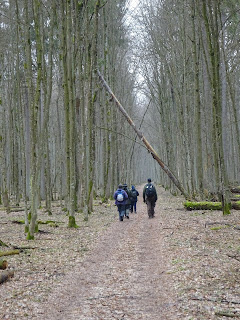
Thankfully there was no rain and reasonable light and we saw and or only heard the following:
Black Woodpecker which we heard in both a stationary call and also the flight call. We had amazing views in particular when one flew in to a hole in a tree. We waited and watched and it re-appeared twice looking skywards and listening to BW calls. Then it flew away. We later had other views and heard many calls.


Lesser-Spotted then obliged calling and giving us some very good views
Middle Spotted was heard and seen frequently.

The same can also be said of Great Spotted.
White Backed was heard and we had some great views.
Being a fully protected area with no felling of trees allowed except for safety reasons. Consequently there were dead trees still standing, broken stumps and much fallen timber.

As a result there were nesting holes and there was evidence to show how they had been feeding.
You could say that this was a Woodpecker day and it was, but in this forest there is so much to see and appreciate. However our list is only short of two and that is the Three Toed Woodpecker and the Green Woodpecker as the Wryneck has still to arrive.
Siskin were high in the trees
Waxwings on their migration perched high up too and two groups were seen.
Hawfinch
Chaffinch
Crossbill - High up in the canopy and heard only
Blue Tit
Great Tit
Crested Tit was called by Andy, but I could not get on it
Marsh Tit singing in the forest. ID'd by Andy
Dunnock was called by Andy
Nuthatches were calling and flying
Mistle Thrush
Tree Creeper
Goldcrests were calling continuously, but again high up
Buzzards flew over and seen twice.
Raven also flew over with nesting material in its beak
Wood Pigeons heard in the distance.
Common Crane - heard only
It is a very pleasant and peaceful feeling walking along the tracks. The trees are straight and tall and seeing some birds is strenuous and hard on the neck!
Flora and Fauna in the National Park.


There were numerous animal signs. Wolf scat on several occasions and paw prints too and also signs of scent marking against tree trunks. Signs of Badger too. Pine Martin not seen, but one faeces seen on the track
Red Squirrels seen with two running and one kindly perched while it ate a pine cone.

Bank Voles were numerous, but scurried around quickly. A food for Owls and Buzzards we were told.
We came to a river where there was a very clear Wolf paw print. On the opposite bank was a Beaver lodge.
On the way out there were a group of three Bison Bulls and with another bull in the distance.
The old Bialowieźa site was where we went just before dusk which is a spot where Pygmy Owl were known to frequent. We did hear one and also a Tawny called in the distance. We had to give up when it was too dark to identify our target bird.
On our return we saw a good photo of one Wolf that was on the track that we had walked along in the National Park . The photograph was taken by a ranger
To add to our list from yesterday I will add both Blue Tit and Great Tit which we had seen before. Importantly we watched two Long Tailed Tits which are the Northern European ones (Caudatus) that had white heads and clearly different to the Europaeus in Britain and the Irbril in south and central Iberia.
Around the hotel are trees, shrubs, and ditches. Bullfinches are numerous here together with European Starlings. When I went outside I could hear a Great Spotted Woodpecker drumming and I then saw two Reed Buntings. I thought that it was a good way to start the day.
On Monday morning we left at 9am to spend six guided hours in Bialowieza Park Narodowy which is a primeval forest where strict rules need to be observed. We only had a short ride to the edge of the park where we de-bussed with our equipment and packed lunches.

Walking through the meadows towards the park entrance we saw two Bison, a Skylark and Yellow Hammer sang. Once inside the habitat was so different with very tall trees, straight trunks and a small canopy at their tops at about 30 metres from the ground.

Thankfully there was no rain and reasonable light and we saw and or only heard the following:
Black Woodpecker which we heard in both a stationary call and also the flight call. We had amazing views in particular when one flew in to a hole in a tree. We waited and watched and it re-appeared twice looking skywards and listening to BW calls. Then it flew away. We later had other views and heard many calls.


Lesser-Spotted then obliged calling and giving us some very good views
Middle Spotted was heard and seen frequently.

The same can also be said of Great Spotted.
White Backed was heard and we had some great views.
Being a fully protected area with no felling of trees allowed except for safety reasons. Consequently there were dead trees still standing, broken stumps and much fallen timber.

As a result there were nesting holes and there was evidence to show how they had been feeding.
You could say that this was a Woodpecker day and it was, but in this forest there is so much to see and appreciate. However our list is only short of two and that is the Three Toed Woodpecker and the Green Woodpecker as the Wryneck has still to arrive.
Siskin were high in the trees
Waxwings on their migration perched high up too and two groups were seen.
Hawfinch
Chaffinch
Crossbill - High up in the canopy and heard only
Blue Tit
Great Tit
Crested Tit was called by Andy, but I could not get on it
Marsh Tit singing in the forest. ID'd by Andy
Dunnock was called by Andy
Nuthatches were calling and flying
Mistle Thrush
Tree Creeper
Goldcrests were calling continuously, but again high up
Buzzards flew over and seen twice.
Raven also flew over with nesting material in its beak
Wood Pigeons heard in the distance.
Common Crane - heard only
It is a very pleasant and peaceful feeling walking along the tracks. The trees are straight and tall and seeing some birds is strenuous and hard on the neck!
Flora and Fauna in the National Park.


There were numerous animal signs. Wolf scat on several occasions and paw prints too and also signs of scent marking against tree trunks. Signs of Badger too. Pine Martin not seen, but one faeces seen on the track
Red Squirrels seen with two running and one kindly perched while it ate a pine cone.

Bank Voles were numerous, but scurried around quickly. A food for Owls and Buzzards we were told.
We came to a river where there was a very clear Wolf paw print. On the opposite bank was a Beaver lodge.
On the way out there were a group of three Bison Bulls and with another bull in the distance.
The old Bialowieźa site was where we went just before dusk which is a spot where Pygmy Owl were known to frequent. We did hear one and also a Tawny called in the distance. We had to give up when it was too dark to identify our target bird.
On our return we saw a good photo of one Wolf that was on the track that we had walked along in the National Park . The photograph was taken by a ranger
Subscribe to:
Posts (Atom)